
Sony A6700 First Impressions: the $1,499.99 APS-C camera that shoots 4K at 120 frames a second
By Merry
At a glance
- The Sony A6700 is $1,499.99 at Best Buy for the body only, checked 17 November 2026 — the same price as yesterday, and no saving at all, just the market holding steady.
- It launched in July 2023 at $1,398, and three years on it still has no successor and no direct rival at its own game: a small body that shoots stills and video at a level that used to need a full-frame camera.
Products in this article: Sony A6700 - Fujifilm X-M5 - Sony ZV-E10 II
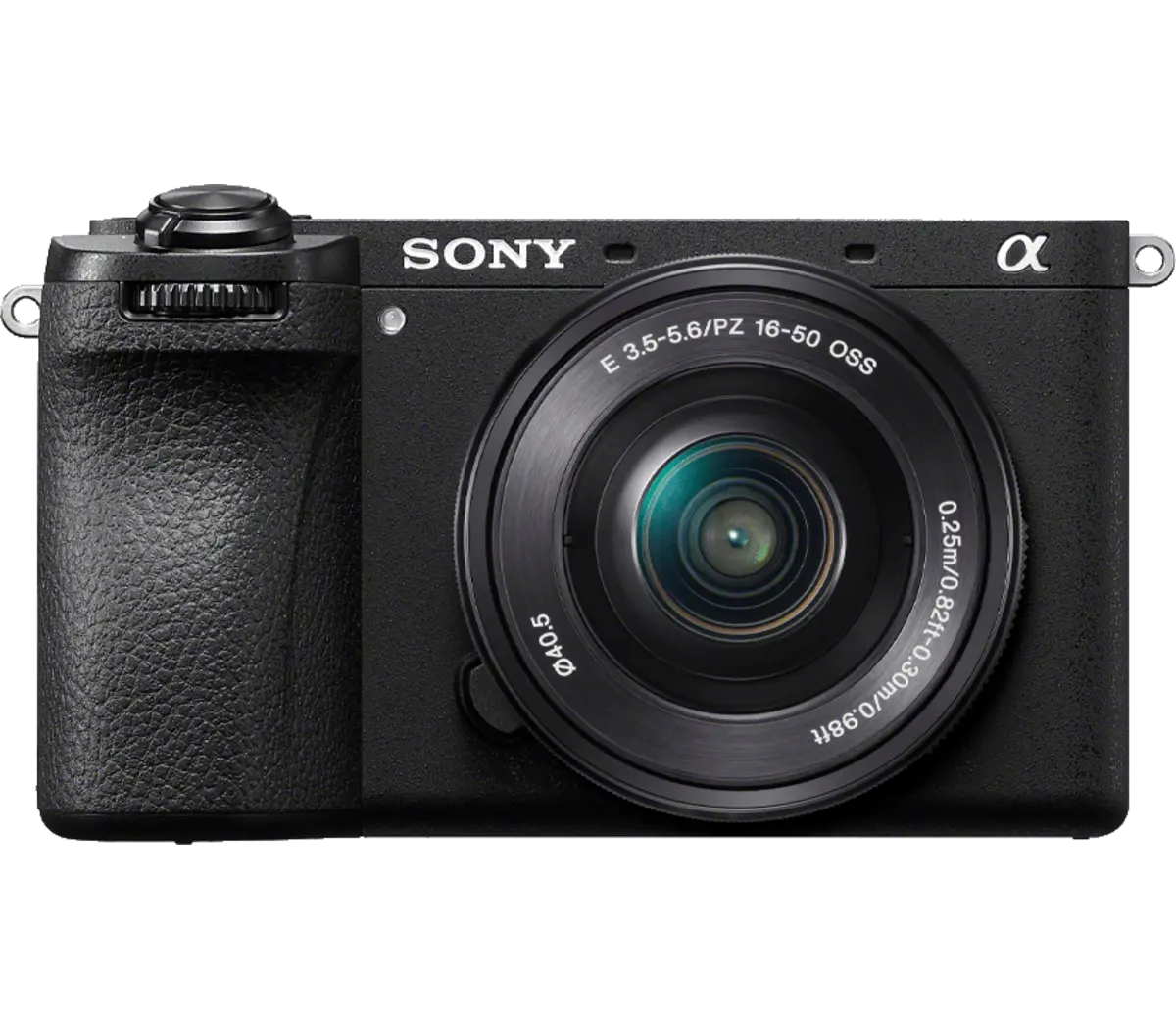
The Sony A6700 is the most capable APS-C camera Sony makes, and it has barely moved in price all month. The Sony A6700 is $1,499.99 at Best Buy for the body only, checked 17 November 2026 — the same price as yesterday, and no saving at all, just the market holding steady. It launched in July 2023 at $1,398, and three years on it still has no successor and no direct rival at its own game: a small body that shoots stills and video at a level that used to need a full-frame camera. First impressions from Sony’s official specifications; we have not hands-on tested the camera.
The autofocus does the work
The A6700’s real advantage is not the sensor but the focus system around it. The 26MP APS-C Exmor R sensor is backed by the BIONZ XR processor and a dedicated AI processing unit, driving 759 phase-detection points across 93 percent of the frame, with Real-time Tracking that holds onto a subject in stills and video and Real-time Eye AF for people, animals and birds. That is the spec that decides whether a camera is usable for a child running across a garden or a bird in flight: the camera finds the eye and stays on it. The stills rate is up to 11 frames a second with autofocus and exposure tracking, the ISO range is 100–32000, expandable to 50–102400, and files are 14-bit RAW. It is the same sensor-and-processor combination Sony put in the FX30 cinema camera, which is why the video numbers look the way they do.
Video is the reason to spend this much
UHD 4K goes up to 120 frames a second, and 4K at 60p is oversampled from 6K in 4:2:2 10-bit — the slow-motion and the colour depth that creators actually notice. Full HD reaches 240p. S-Log3, S-Gamut3 and S-Cinetone are all there, with user LUTs, and the 5-axis in-body stabilisation works at pixel level, with an Active Mode for walking shots. The screen is a 3-inch vari-angle touchscreen, so it flips out for self-filming, and the battery is the NP-FZ100, the same large cell Sony uses in its full-frame bodies. At 409g for the body, it is a camera that fits in a jacket pocket with a small prime lens on it — and that is the point. The video spec sheet is stronger than anything else at this price in an interchangeable-lens body.
The price is the argument
At $1,499.99 the A6700 costs $600.00 more than the Fujifilm X-M5 at $899.99 — read our first impressions of the X-M5 before deciding, because the Fuji is smaller, lighter and prettier, and its film simulations are the reason many people buy it. But the X-M5 has no in-body stabilisation and a slower autofocus system, and it cannot shoot 4K at 120p. The Sony ZV-E10 II is $1,199.99, $300.00 less, and it is the better pure video camera for a vlogger — but it has no viewfinder and no mechanical shutter, so it is not a stills camera at all. The Canon EOS R50 V is $569.99, $930.00 less, and it is the value pick in our best mirrorless cameras under $1,000 guide — but it is a smaller sensor with a simpler autofocus system. The Nikon Z50 II is $1,349.95 as a two-lens kit, $150.04 less, and it is the only camera here that arrives with lenses in the box. The A6700 is the one body that does all of it: viewfinder, stabilisation, 4K120, and autofocus that holds a moving subject.
At a glance
- 409g body only (493g with battery and card); NP-FZ100 battery, the large Sony cell.
- 759 phase-detection points, 93% frame coverage, AI subject recognition.
- 4K120p and 4K60p from 6K oversampling, 10-bit 4:2:2, S-Log3 and S-Cinetone.
- No lens in the box at $1,499.99 — budget for glass on top.
- Launched July 2023; no successor announced.
Pros
- The autofocus system — 759 points, AI recognition, Real-time Tracking — is the best in any APS-C camera we track.
- 4K120p and 6K-oversampled 4K60p in a 409g body, with 5-axis stabilisation and the large NP-FZ100 battery.
- One body for stills and video, with a viewfinder, where the cheaper video cameras force a choice.
Cons
- $1,499.99 buys the body only — a lens is an extra purchase, and a good one costs hundreds more.
- At three years old it has no successor yet, so a replacement could arrive while this one is still full price.
- The 26MP sensor is unchanged from launch; the gains over the X-M5 are autofocus and video, not resolution.
CompareIdea verdict
Buy the Sony A6700 if you shoot both stills and video and want one small body that does both properly — the autofocus and the 4K120 video are the reasons to pay $1,499.99, and nothing else at this price combines them with a viewfinder and in-body stabilisation. The trade-off is the price and the empty box: $1,499.99 with no lens, against the X-M5 at $899.99 for stills-first shooters and the ZV-E10 II at $1,199.99 for video-only work. If video is the whole job, save $300.00 and take the ZV-E10 II. If the camera has to do everything, this is the one to buy — and at $1,499.99, with the price unmoved all month, there is no reason to wait for a discount that has not come.
Sources
- Sony — A6700 official help guide (https://helpguide.sony.net/ilc/2320/v1/en/index.html) — sensor, processor, autofocus, video formats, stabilisation, screen, battery.
- Best Buy — Sony A6700 listing (https://www.bestbuy.com/product/sony-alpha-6700-aps-c-mirrorless-camera-body-only-black/J7XSRH58FC) — $1,499.99, checked 17 November 2026.
- Best Buy — Fujifilm X-M5 listing (https://www.bestbuy.com/product/fujifilm-x-m5-mirrorless-camera-body-black/J7929VCRFR) — $899.99, checked 17 November 2026.
- Best Buy — Sony ZV-E10 II listing (https://www.bestbuy.com/product/sony-alpha-zv-e10-ii-mirrorless-content-creators-camera-body-only-black/J7XSRH563F/sku/6589377) — $1,199.99, checked 17 November 2026.
- CompareIdea price watch, 17 November 2026 — Canon EOS R50 V $569.99, Nikon Z50 II $1,349.95, both checked 17 November 2026.
Last updated: 17 November 2026